
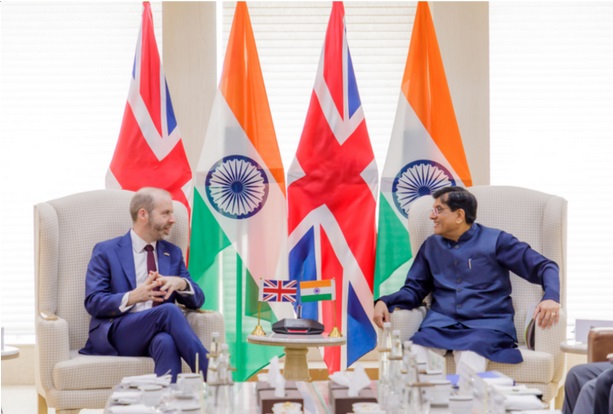
India and UK Sign Landmark Free Trade Deal to Boost Bilateral Trade and Employment
India and the United Kingdom have officially signed a landmark Free Trade Agreement (FTA) aimed at deepening economic cooperation and opening new trade opportunities across multiple sectors.
The deal, signed today in London by Commerce Minister Piyush Goyal and his British counterpart Jonathan Reynolds, comes after three years of intense negotiations and is being hailed as the largest bilateral trade pact the UK has concluded since leaving the European Union.
The FTA will remove tariffs on 99% of Indian exports to the UK significantly enhancing market access for Indian goods like leather, textiles, footwear, and clothing.
UK exports to India, including whisky, gin, soft drinks, cosmetics, medical devices, and automobiles, will see tariffs drastically reduced from up to 150% to as low as 3% over a phased timeline.
The deal is expected to boost bilateral trade by up to $34 billion annually with ambitions to double trade to $120 billion by 2030 and further increase by $40 billion by 2040.
It includes provisions for employment and skill development aiming to create jobs and enhance professional mobility for Indians in the UK, alongside trade facilitation measures that will simplify customs procedures and use digital systems.
India will also gain easier access for UK firms in sectors such as telecom, banking, and insurance, while the UK firms will benefit from the ability to bid for Indian government tenders.
The agreement addresses visa arrangements and intellectual property rights, with India agreeing to some IP rules exceeding WTO norms, which has raised concerns about medicine costs.
Both sides committed to mutual recognition of sanitary and phytosanitary standards to ensure smooth and safe trade flows.
Indian Prime Minister Narendra Modi, present in London for the signing, described the deal as a historic and ambitious step that will promote prosperity, growth and job creation for both countries.
UK Prime Minister Keir Starmer called the agreement a major win for Britain that will reduce costs for consumers and open up Britain’s largest export market outside the EU.
The pact also includes social security arrangements exempting Indian workers’ employers from paying UK social security contributions, supporting mobility and labor collaboration between the two nations.
This agreement marks the first comprehensive FTA India has concluded with a European country and represents a significant milestone in India’s global trade strategy.
It is expected to strengthen economic ties, foster innovation, and provide a platform for long-term cooperation on global issues such as sustainable development and fair trade practices.
The tariff reductions and market access will likely stimulate industries across sectors such as textiles, engineering goods, IT services, agriculture, beverages, advanced manufacturing and life sciences in both countries. This is projected to create numerous job opportunities and facilitate skill development through increased collaboration.
With the formal signing completed, the India-UK Free Trade Agreement is set to come into force soon, enabling businesses from both countries to capitalize on the new liberalized trade framework.
Observers note that while some challenges remain regarding regulatory alignment and specific sector protections, the agreement provides a robust foundation for growing bilateral trade and deeper economic partnership.
