
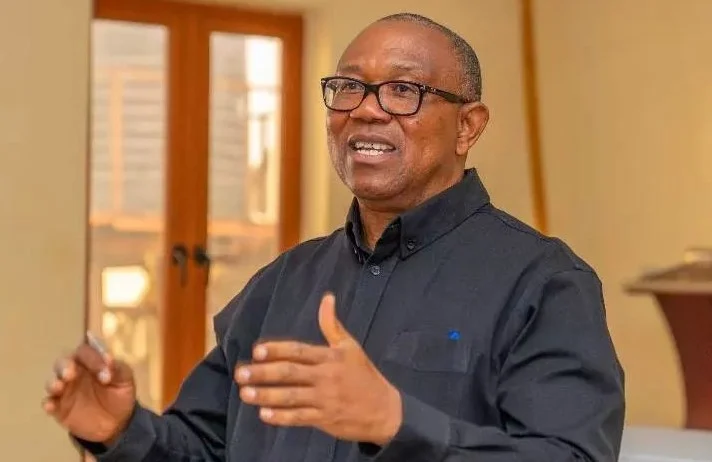
Peter Obi’s One-Term Pledge Is Empty Rhetoric — Farouq Aliyu
Former Minority Leader of the House of Representatives, Farouq Aliyu, has criticized Labour Party’s Peter Obi over his recent pledge to serve only one term if elected president in 2027.
Aliyu dismissed the vow as “mere rhetoric,” suggesting that it highlights Obi’s lack of understanding of the complexities involved in governing Nigeria.
Speaking during an interview on Prime Time, a current affairs programme on Arise Television, Aliyu claimed that the former Anambra State governor lacks the national-level experience necessary to make credible commitments of such magnitude.
According to him, Obi’s statement is more about political marketing than informed governance strategy.
“Sometimes when you’re out of office, or when you’re not in the place, you don’t know what really happens,” Aliyu remarked. “To me, it’s just rhetoric, and he’s also trying to convince people.”
He elaborated that managing a state government is vastly different from running a country like Nigeria. In his view, Obi’s gubernatorial experience offers a limited perspective that doesn’t adequately prepare him for presidential leadership.
“Obi is talking out of ignorance,” Aliyu said. “He doesn’t know. States are different from Nigeria. When you govern a small state, the horizon of a state governor is not as wide as the horizon of a president.”
Peter Obi recently restated his readiness to serve just one term if elected, saying he would use the time to lay a strong foundation for what he called a “new Nigeria.”
The one-term pledge is positioned as a self-imposed check to ensure accountability and focused leadership, but Aliyu sees it as unrealistic and disconnected from the realities of national governance.
Addressing the growing coalition of opposition parties, including the Labour Party and the African Democratic Congress (ADC), Aliyu also downplayed the group’s relevance. He argued that despite the media attention around the movement, it lacks the internal cohesion, structure, and strategy necessary to challenge the ruling All Progressives Congress (APC).
“We respect them; we admire them as Nigerian leaders, but honestly, they don’t threaten us,” he said. “All of them are after us. So, we need to spread our tentacles to make sure we pour sand inside their gàárì.”
Aliyu went on to question the unity of the coalition, describing it as a gathering of individuals driven by personal presidential ambitions rather than a shared national vision.
“Virtually all leaders of that group want to be president; unfortunately for them, only one person can be president,” he noted.
Although he acknowledged that some opposition figures make valid criticisms, Aliyu concluded that their fractured and competitive structure renders them ineffective against the APC in the run-up to the 2027 elections.
