
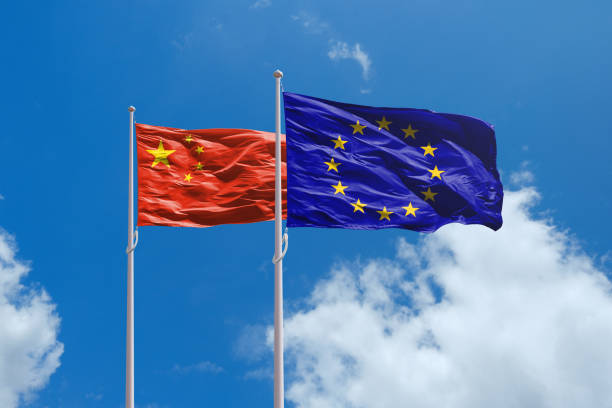
Why the EU Should Reconsider Its Alliance With the United States and Look to China
As Donald Trump forges ahead with a turbulent second term as U.S. president, the European Union faces a defining crossroads in its global alliances.
A growing number of observers argue it may be time for the EU to loosen its historical ties with Washington and consider a strategic pivot towards Beijing.
During a recent meeting in April, Chinese President Xi Jinping called on Spanish Prime Minister Pedro Sanchez to encourage the EU to “resist together” against the United States’ increasingly unilateral and coercive behaviour.
According to Xi, the U.S. is no longer just meddling in trade it is dictating global cultural, political, and strategic narratives. This shift forces Europe to confront a pressing question: Is the United States still a suitable partner in today’s multipolar world?
Under Trump, America’s global image has taken a darker turn. From unconditional support for Israel’s war in Gaza widely criticized as genocidal to the greenlighting of new military aggression in Iran and sweeping domestic crackdowns on academic and civil freedoms, the U.S. is distancing itself from the democratic values it once championed. Trump’s administration has been accused of undermining human rights, promoting wealth inequality, and marginalizing dissent.
Basic democratic institutions are being eroded. Whistleblowers like Julian Assange, Edward Snowden, and Chelsea Manning have faced harsh treatment for exposing truths, while social media platforms controlled by tech billionaires have become breeding grounds for misinformation. As this trend continues, the question arises: Is the West’s model of democracy still a reliable standard?
To be clear, China is not without its flaws. Press censorship, limited political freedoms, and tight government control persist. However, from a geopolitical standpoint, Beijing has shown more restraint than Washington. China maintains just one overseas military base, while the U.S. operates over 750 globally.
Recent rhetoric from Trump, including imagining Gaza as a “Riviera” after forced Palestinian displacement, contrasts sharply with China’s consistent stance supporting Palestinian sovereignty and opposition to foreign occupation.
In education, China is emerging as a strong alternative to the U.S. With over 3,000 universities serving more than 40 million students, and tuition fees a fraction of what U.S. institutions charge, it offers an affordable path for international learners. While academic censorship exists, leading institutions like Tsinghua University are gaining global recognition.
Despite these shifts, Europe remains entangled in outdated dependencies. Its lack of unified military, tax, and labour systems means true political sovereignty still eludes the EU. Fragmented across language, culture, and national interests, the continent is unable to evaluate its global role independently.
Although leaders like Emmanuel Macron have spoken about “European sovereignty,” it remains more aspiration than reality.
For now, the EU’s strategic reflex continues to lean Westward. But Trump’s administration, with its aggressive and destabilizing policies, may unintentionally accelerate the EU’s re-evaluation.
As China signals readiness for deeper cooperation, the time may be near for Europe to reconsider not just who its allies are but why.
